What Is Waterfall Enrichment and Why Does It Beat Single-Source Data?
You upload a thousand target contacts to the platform you already pay for, and four hundred come back blank. No email, no direct dial,…
Read more
You’re three meetings into working out how to choose a data enrichment provider. Right now, you are comparing three decks and three accuracy percentages. However, you have no way to compare them, because none of the suppliers will say how that percentage was measured.
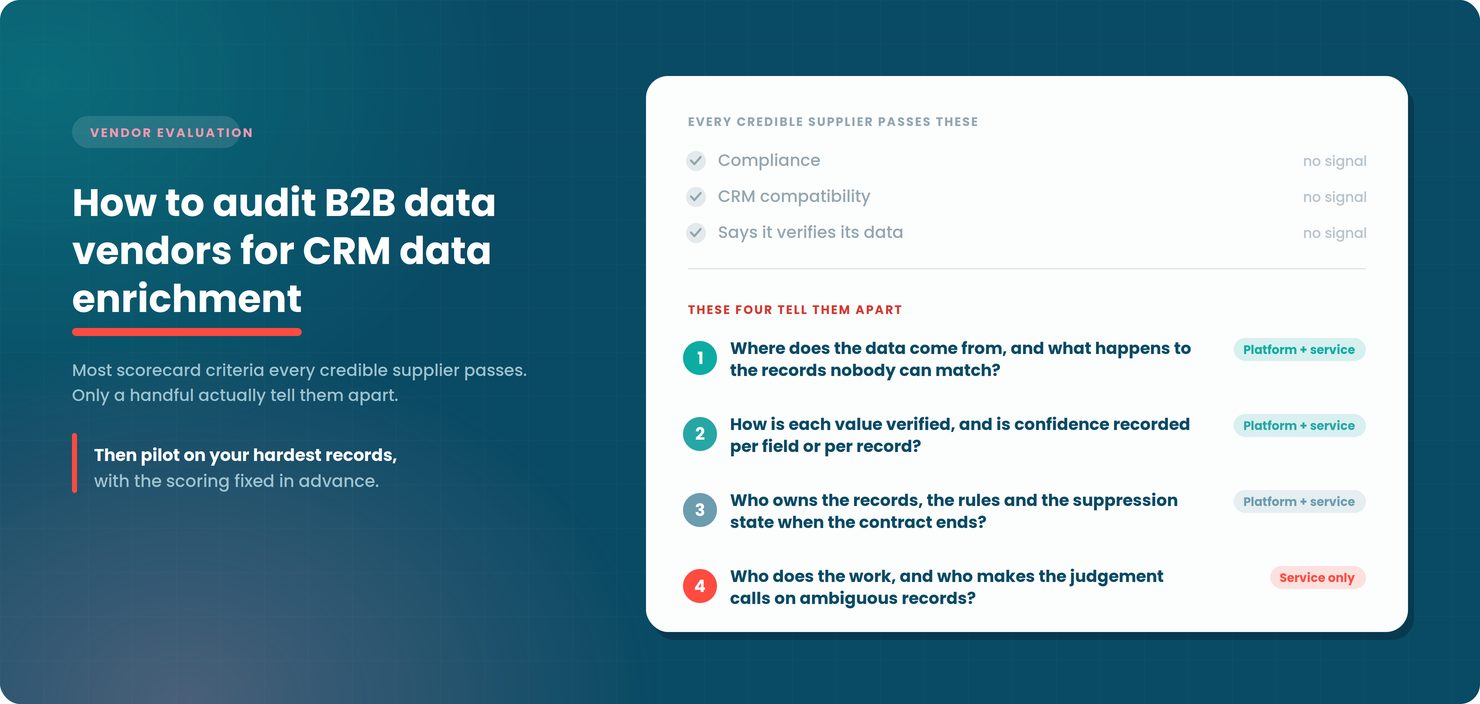
That’s the usual shape of a B2B data vendor evaluation: confident claims in a near-identical format, with nothing underneath to tell the suppliers apart. Some scorecard criteria are less useful at distinguishing credible supplier; only a handful of questions actually discriminate.
Before you get specific in your B2B data vendor evaluation, decide whether you want to go with a platform or a service.
A platform is data you license and query yourself. It is self-service, with subscription and usage-based pricing . A service is a supplier that builds the dataset to your spec and returns it enriched. Still deciding between the two? See data enrichment API vs data consultancy service.
Three of the four questions to ask a data provider below apply to both; the fourth, who does the work, applies to services only.
What Should You Ask A Data Enrichment Provider Before Signing?
Start by separating essential requirements from differentiators. Compliance, verification and CRM compatibility still need to be assessed, but you’re unlikely to see differentiation here e, so a B2B data vendor evaluation solely built on them produces near-identical scores, and the decision comes down to rapport.
The four below apply to platforms and services alike, except the fourth, which applies to services only. These questions are worth asking because 76% of surveyed CRM users and stakeholders said less than half of their organisation’s CRM data is accurate and complete (The State of CRM Data Management in 2025), and 81% of B2B buyers end up dissatisfied with the provider they picked (Forrester).
If a supplier won’t name sources, even broadly, rule them out on the spot, because you inherit their sourcing decisions, including compliance.
In 2025 alone, the ICO fined one company £90,000 for unlawful marketing calls where valid consent could not be demonstrated, and two energy firms £550,000 between them for unlawful automated marketing calls.IMG’s (Intermedia Global Ltd) enrichment approach draws on multiple sources that have been established as “trusted, compliant sources.” Clients should ask their provider what sourcing and compliance checks apply, and clarify the relevant lawful bases.
The sharper test is what happens to records nobody can match. A weak supplier quietly drops them and reports a strong match rate on whatever’s left. A strong one hands back an explicit not-found list, with reasons.
Buying a platform? Check whether its response distinguishes no match from low confidence, or just returns a blank. Buying a service? Ask to see a redacted exceptions output from a real engagement and not a demo.
Every supplier says it verifies its data, but the real test is how, and against what.
Is an email checked for deliverability, as only 83.5% of legitimate B2B sends reach the inbox, or just for format? Is a phone number validated by line type? Is a job title confirmed against a second source, or copied from whichever source returned it first?
Then ask whether confidence is recorded per field or per record. A single record-level score hides what you need to know: the same record can be solid on company data and shaky on the direct dial.
Ask when it was last checked, too, because a value checked eighteen months ago and one checked last week can both be filed as verified contact data.
Three things need settling before you sign.
1. Who owns the enriched records
2. The rules
3. The suppression state, and is any of it only licensed?
Licensing is more common with platforms than buyers expect. For a service, is the method documented well enough that someone else could pick it up? And on exit, what format do you get everything back in, and how fast?
Ask IMG (Intermedia Global Ltd)to confirm the agreed delivery format and any usage or retention restrictions. We can supply the data “in the same format you supplied it” so uploading it into your CRM or system of record is simple. The goal is a capability you keep, not a dependency you renew.
Now this question is pertinent if you are choosing services only. The people in the room during selection are frequently not the people doing the delivery.
So, ask directly: who’s assigned, what’s their experience with this kind of work, how much is subcontracted or offshored, and will you be told if that changes mid-engagement?
Then move on to who makes the judgment calls on ambiguous records? That’s rarely the person who pitched you. Get the named team written into the statement of work, not left in the proposal deck. If the answers here make you doubt the model altogether, it’s worth asking whether to hire an In-House Data Team vs Data Consultancy.
Procurement teams have used strong-answer/weak-answer scorecards for years. These ten are built specifically for how to choose a data enrichment provider, not generic supplier vetting.
| Criterion | Strong answer | Weak answer | Applies to |
|---|---|---|---|
| Source transparency | Names sources and the lawful basis without being asked | “Multiple trusted sources,” no names, cites confidentiality | Both |
| Unmatched records | Explains no-match handling and provides an exceptions output where agreed | Silently drops them; quotes a match rate on what’s left | Both |
| Verification & confidence per field | States the method per field; confidence scored per field | “Verified” with no method; one score for the whole record | Both |
| Output ownership | Client has clearly documented rights to use, retain or export records, rules and suppression data, subject to licence and privacy obligations | Ownership is vague; some elements are only licensed | Both |
| Portability at exit | Named format and timeframe, confirmed in writing | “We’ll sort it when you leave” | Both |
| Delivery team & judgement calls | Named team in the SOW; a named owner for ambiguous records | “A dedicated team,” no names; unclear who decides | Service |
| Method documentation | Written up well enough for someone else to continue it | Lives in one person’s head | Service |
| Pilot terms | Comparable agreed test data, scoring fixed in advance; commercial terms clear | Will not agree a comparable test methodology | Both |
| Commercial incentive & declines | Names its model’s incentive and one thing it won’t do | Claims every capability; declines nothing | Both |
| Recency of verification | States when each value was last checked | “Verified” with no date attached | Both |
Testing before you sign is something that procurement teams have always done. What’s missing from most advice is the design, and that’s where a data enrichment pilot either earns its keep or wastes a fortnight.
Every pricing model creates an incentive, and none is neutral.
The incentive exists whether or not anyone acts on it, so price it into any B2B data vendor evaluation rather than assuming good faith. Ask the supplier to name its own model’s incentive and how it manages it.
Pricing models are changing. Seat-based pricing is already losing ground, down from 21% to 15% of companies in a year, with hybrid models rising from 27% to 41%. But the terms and usage assumptions of each proposal matter more than headline market averages. Ask what happens if usage, coverage needs or project scope change.
Multi-source services like IMG (Intermedia Global Ltd) enrich records in sequence; one source fills what the last one missed, which changes how the four questions land.
Provenance becomes a per-field question, i.e., which source supplied this value, not just which supplier. A record remains unmatched after the sources agreed for that project have been checked without a usable result.
The exceptions output is whatever’s left after the last one. Ask how confidence and provenance are recorded for individual fields. This is how IMG enriches CRM data; ask any multi-source provider the same question: which source supplied which field, rather than assuming more sources automatically means a better result.
None of these disqualifies a supplier outright. They’re signals to probe further in any B2B data vendor evaluation, not automatic rejections. Listen for:
If several of these show up together, go back to the questions to ask a data provider above. The scorecard already tells you what a strong answer sounds like.
None of this works unless you brief the provider against the campaigns you’ve actually committed to: which roles you need to reach, which markets and segments, and what the output must support.
According to Forrester, B2B buying decisions involve around 13 people on average, and buying groups commonly run five to sixteen across several functions, as stated by Gartner. The right coverage requirement depends on the roles involved in your actual buying groups. A supplier who can’t help you reach those isn’t solving your real problem.
The outcomes to look for are clear:
IMG (Intermedia Global Ltd) is a London-based B2B marketing consultancy, so this applies to us just as much as to any provider you may be considering. Our own marketing data enrichment services work follows the same four questions. We believe this shows that choosing a data enrichment provider and building a marketing data strategy are closely connected.
References:
1. Validity Inc. (2026, January 29). The State of CRM Data Management in 2025 – Validity. Validity. https://www.validity.com/resource-center/the-state-of-crm-data-management-in-2025/
2. Forrester. (2024, December 4). Forrester: The State of Business Buying, 2024. https://www.forrester.com/press-newsroom/forrester-the-state-of-business-buying-2024/
3. ICO. (n.d.). Compensation company fined £90,000 for unlawful marketing calls. https://ico.org.uk/about-the-ico/media-centre/news-and-blogs/2025/04/compensation-company-fined-90-000-for-unlawful-marketing-calls/
4. ICO. (n.d.-b). Warning over robo calls as energy firms fined half a million pounds for unlawful marketing calls. https://ico.org.uk/about-the-ico/media-centre/news-and-blogs/2025/09/warning-over-robo-calls-as-energy-firms-fined-half-a-million-pounds-for-unlawful-marketing-calls/
5. Validity. (2025). Email Deliverability 2025 Benchmark Report: An Analysis of Inbox and Spam Placement Rates Worldwide. https://www.validity.com/wp-content/uploads/2025/03/2025-Benchmark-Report-FINAL.pdf
6. Poyar, K. (2026, May 21). The state of B2B monetization in 2025. Kyle Poyar’s Growth Unhinged. https://www.growthunhinged.com/p/2025-state-of-b2b-monetization
7. Gartner Sales survey finds 74% of B2B buyer teams demonstrate “Unhealthy conflict” during the decision process. (2025, May 7). Gartner. Retrieved October 26, 2026, from https://www.gartner.com/en/newsroom/press-releases/2025-05-07-gartner-sales-survey-finds-74-percent-of-b2b-buyer-teams-demonstrate-unhealthy-conflict-during-the-decision-process