What Is Waterfall Enrichment and Why Does It Beat Single-Source Data?
You upload a thousand target contacts to the platform you already pay for, and four hundred come back blank. No email, no direct dial,…
Read more
Most explanations of data enrichment describe a mechanism, not a method. Records go in, fields come out. That’s accurate for a tool, but it says nothing about how a managed engagement actually runs or where the judgement sits.
This is for anyone weighing up whether to hand their CRM data to a partner, and who wants to see the working first. In 2025, 76% of CRM users and admins said less than half of their CRM data was accurate and complete (1). That gap is one of the problems IMG’s (Intermedia Global Ltd marketing data enrichment service aims to address
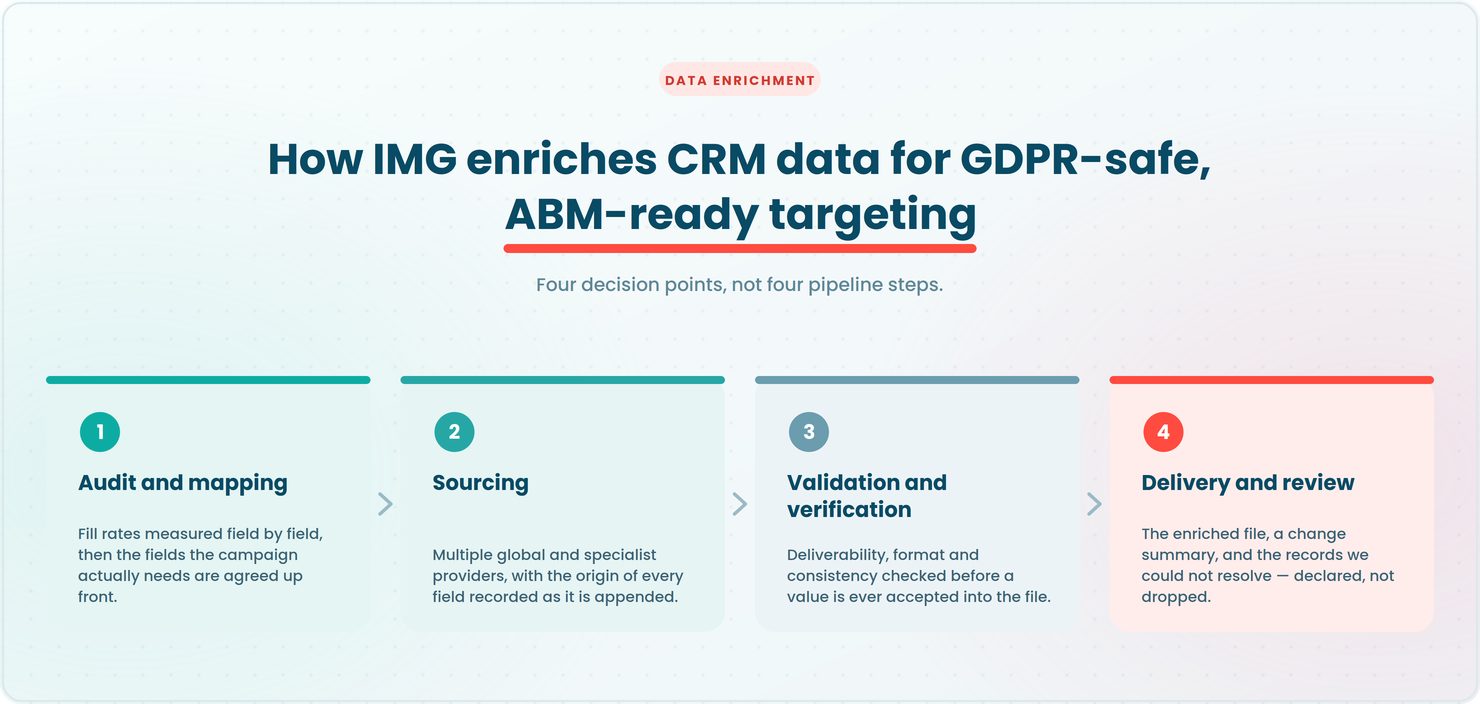
At IMG (Intermedia Global), a London-based B2B marketing consultancy, our data enrichment process runs in four stages that we will discuss in the coming sections.
Each stage is a decision point, not a pipeline step. We’ll also set out plainly what GDPR compliant data enrichment can’t fix, because that matters as much as what it can.
IMG (Intermedia Global) begins every engagement with one question:
What does Marketing need to do next?
We start with your marketing data strategy, and work backwards to the fields that strategy actually requires. Our data enrichment process runs in four stages:
Each one has a clear deliverable, but none of them run the same way twice. That distinction matters more than it sounds.
In a software platform, these are pipeline steps. They run in a standardised way across clients, which is why a product’s process page can be written once and left unchanged.
In a managed engagement, they are decision points instead. The decisions we make at each stage differ by client, by sector, by market and by the objective behind the campaign.
That is why two organisations can run identical fields through identical providers and still end up with results that are not comparable. The outcome rests on the decisions made at each of these data enrichment steps, not on the providers alone.
This is the stage that decides the outcome of the data enrichment process, and it’s an area where consultancy can add value. Some platforms also offer auditing capabilities, but a platform’s work only begins once you send it a record. Our work begins earlier. It starts with reviewing your data and objectives and a CRM data audit.
We start with fill rates by field, because an average conceals exactly which fields are empty, and the average is what most reporting shows.
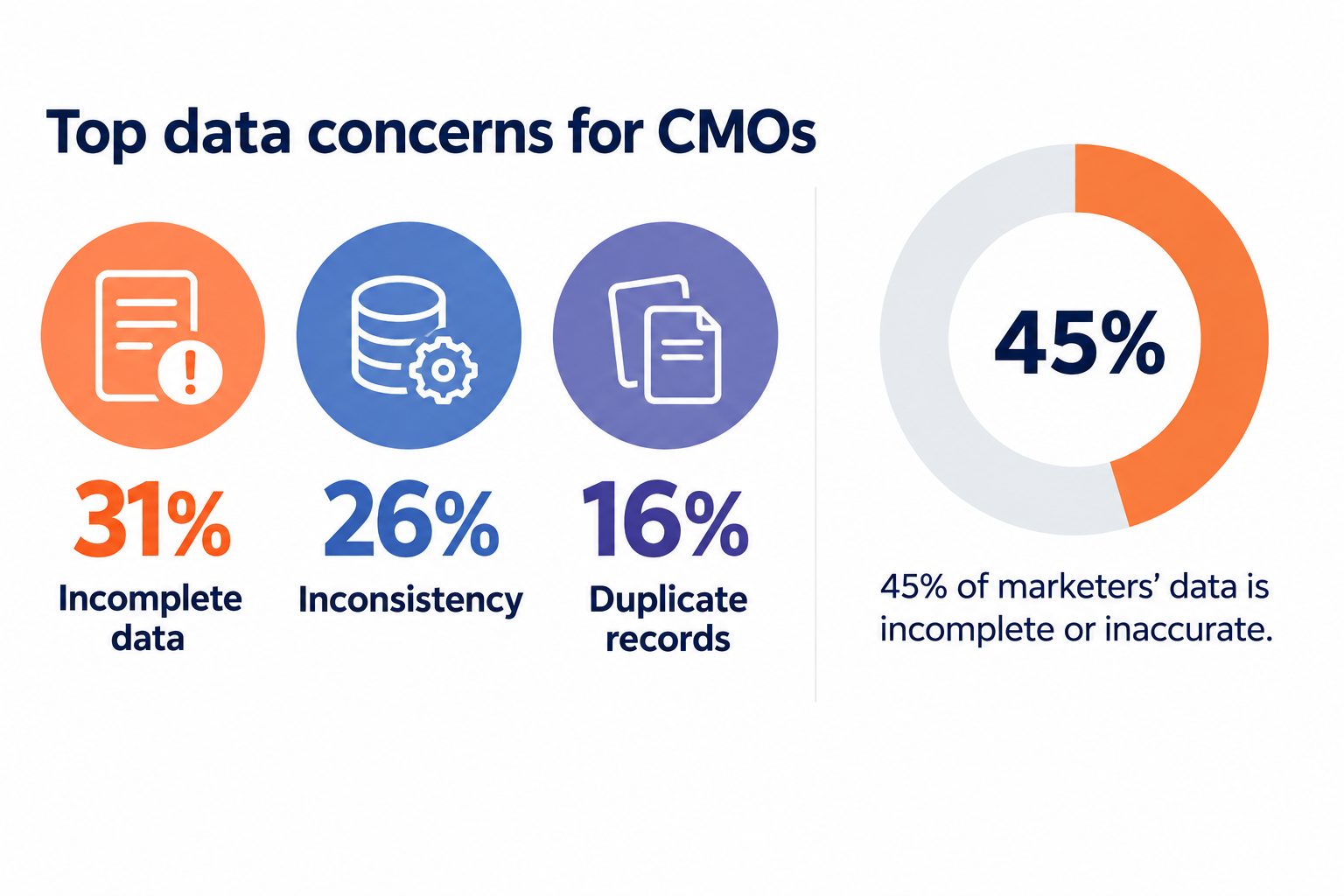
According to the Fixing the Foundation: The State of Marketing Data Quality Report 2025, incomplete data tops the list of CMO concerns at 31%. Consistency follows at 26%, with duplicates close behind at 16%. On average, CMOs estimate that 45% of the data marketers use for decisions is incomplete, inaccurate or outdated. (2)
Fixing the Foundation: The State of Marketing Data Quality 2025
This is where IMG’s (Intermedia Global) data audit earns its place, alongside TAM definition and ICP development. Our audit compares your CRM against the market you could address, so it shows which target accounts you already hold, which are missing, which are duplicated, and which need enrichment.
Duplication matters because appending to a duplicate means paying twice, then losing one record at merge. That’s a job for a marketing data cleansing service, resolved before anything gets enriched.
We also look at record age and last-write dates, since a field that’s wrong looks identical to one that’s merely old in a completeness report. And we treat thin segments differently from small ones, since sourcing handles each differently.
Aforementioned research suggests that leaders estimate 26% of organisational data is untrustworthy. Our audit helps assess how much of your own data is trustworthy, rather than relying on industry averages.
So how does Intermedia Global approach data enrichment? By measuring what’s actually there before deciding what needs to be added.
This is the decision that matters most, and it’s the one most often made backwards. Fields get chosen by working back from what the marketing programme has to do, not forward from whatever a provider happens to hold.
A programme segmenting by seniority needs different fields from one that needs full buying group coverage. Get that wrong, and the cost stays invisible until activation fails, by which point the spend is already gone.
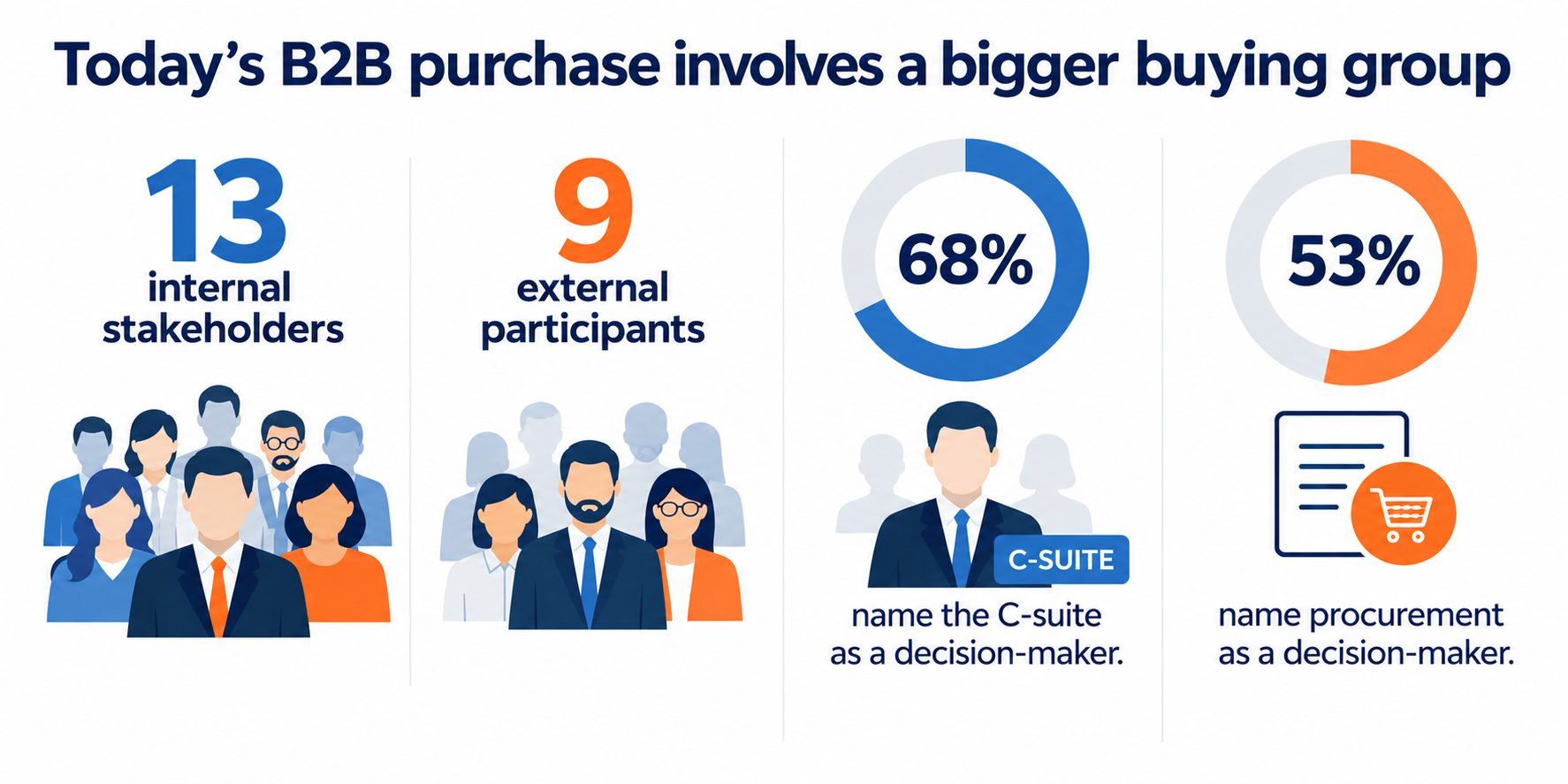
In practice, buying group coverage means economic buyers, technical evaluators, operational stakeholders, procurement, and finance. The State of Business Buying, 2026, by Forrester states that the average B2B purchase now involves 13 internal stakeholders and nine external influencers.
Forrester still reports 68% naming the C-suite as a decision-maker, but 53% observed procurement professionals as decision-makers in business buying cycles, often engaging from the start.
That discipline is what a buying-group programme needs in the data. Every field earns its place for a stated reason, or it’s a cost with no return. Guesswork doesn’t survive contact with a campaign brief.
No single provider covers a whole market, and we don’t pretend one does. Coverage gaps follow how each provider collects its data, which is why they tend to fall along the same lines: by sector, by sub-sector, by seniority or by geography.
A platform might have excellent UK coverage and weak coverage across the Nordics, or strong data at director level and very little below that. Those gaps don’t average out. They just sit there, quietly limiting whichever campaign depends on the thin part.
That’s how we work across multiple sources. Records move through several global and specialist providers rather than one, as part of the same data enrichment process. We’re source-agnostic in practice, not just in name: we aren’t tied to a single database, and the right combination depends on the markets, sectors, roles, and seniority levels a client actually sells into.
This is multi-source data enrichment at work, or what IMG (Intermedia Global) calls waterfall enrichment. Where appropriate, records can pass through sources in sequence to address fields that earlier sources did not supply.
Specialist local and industry sources often go deeper here than the big global platforms, which is why we rely on global-plus-local sourcing rather than scale alone. It’s also how we answer a question prospects ask directly:
Which agencies run compliant multi-source data enrichment, and can they name their sources?
Recording provenance is an important part of responsible data enrichment, but it does not by itself establish GDPR compliance. Reconstructing provenance later may be difficult or unreliable.
Before anything gets appended, we decide which sources are admitted and what we know about how each one collects its data. We also decide what gets recorded about each field’s origin, at the moment it’s appended rather than afterwards.
Recording the source when a field is appended helps retain a reliable audit trail: reconstructing that information later can be difficult.
The client will often act as controller for its CRM data, although controller and processor responsibilities depend on the parties’ actual roles and arrangements. We’re simply clear about where that decision gets made, at the point of sourcing rather than in some compliance review afterwards.
Provenance supports GDPR compliant data enrichment and handling, alongside the appropriate lawful basis, transparency, individual rights, data minimisation, security and applicable marketing rules. Compliance depends on the specific processing and use case.
Being source-agnostic isn’t a claim we make about our data enrichment agency process. It’s simply how we work.
If you already hold a data platform licence, we treat it as the first rung, not something to replace. You’ve already paid for that coverage, so we use it wherever it’s strong.
What we add is whatever your existing licence doesn’t reach: the markets, sectors, roles and seniority levels where that provider runs thin. That’s multi-source data enrichment in its most practical form, built on top of what you already own rather than instead of it.
So what happens to records an enrichment provider can’t match?
They move to the next source in the sequence, rather than coming back unresolved. Use the tools and data you already have, and let us fill the gaps, rather than repurchasing coverage you’re already paying for.
A source doesn’t get used just because it has the coverage we’re missing. Before it’s admitted, we document how it collects its data and what its processing terms actually allow, the same way every source enters our data enrichment agency process.
That check should happen when a source is first considered and be revisited when circumstances or terms change. It’s one of the quieter data enrichment steps, easy to overlook when a source looks strong on the surface.
If a source can’t show us how it collects data or what it does with it afterwards, it doesn’t get admitted, regardless of how good its coverage looks on paper. That’s non-negotiable in IMG data enrichment.
A provider returning a value is a claim. That’s the real difference between verified vs. found contact data.
This is where IMG’s (Intermedia Global) data validation sits in the data enrichment process, the step between a provider’s first answer and what actually lands in your CRM. Our email validation service checks deliverability before a record is accepted, not after it bounces at send.
That order matters more than it sounds. One in six marketing emails never reaches the inbox, and the global inbox placement rate sits at 83.5% (3). Inbox placement depends on factors beyond contact-data quality, including sender reputation and email authentication. Checking deliverability before acceptance can reduce address-related delivery failures. It’s what keeps a dataset from carrying that failure rate forward and stops you from putting your brand at reputational risk.
Phone numbers get the same treatment. We check format and line type before a number is treated as usable, rather than letting a call team discover it’s wrong.
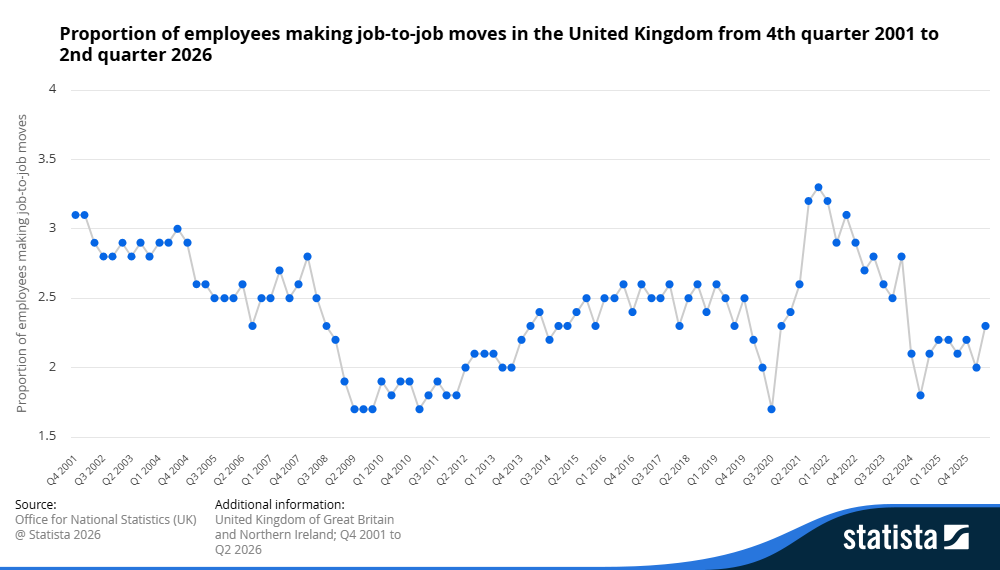
Internal consistency is next. If a job title and a seniority field disagree, the record may be outdated or inconsistent. .Roles change over time, so that kind of drift needs monitoring. For example, UK employees changed jobs at a rate of around 2.3% a quarter over the past year.
Cross-source agreement works the same way. When two providers return different values for the same field, that may signal a change or an inconsistency, not a tie to break arbitrarily. This is the clearest illustration of verified vs found contact data: a found value is simply what a provider holds, while verification involves appropriate live checks against the available evidence.
This is what separates IMG data enrichment from a list that merely looks complete. The checks happen before anything is accepted, not after a campaign exposes the gap.
A single confidence score per record hides exactly what an activation decision depends on. A record can be completely solid on company data and still unreliable on direct dial, and one score from a single stage of the data enrichment process can’t show you both.
That’s why we record confidence field by field instead, as a standing part of our data enrichment agency process. An email-led programme can use records whose phone data is weak, and a telemarketing programme can do the reverse, because each one is selecting on what’s actually dependable rather than an average.
This is what verified contact data actually means in practice: not a single pass or fail, but a dependable picture of which fields you can trust and which you can’t. It also pays off later: the next refresh can target the weak fields specifically, rather than reprocessing a record that was already solid everywhere else.
This is where the first three stages pay off.
Some providers focus mainly on appending fields. That’s where their data enrichment process ends, and it’s exactly where ours gets more useful.
You get more than an enriched file back. There’s a change summary alongside it, and a list of what we couldn’t resolve, so each piece answers a different question.
The enriched file itself carries a source and a date for every appended field, not a single note claiming the whole record is enriched. That level of detail is what can separate a data enrichment agency’s output from what a self-serve tool hands back.
So what does a data agency do that an enrichment tool doesn’t? It can add tailored assessment and reporting on where values came from and when, according to the agreed scope.
A tool can tell you a field is populated. It can’t tell you whether that’s trustworthy, or where it came from before today. A managed engagement can add reviews tailored to your data and campaign requirements. The change summary works the same way. It shows fill rates before and after by field and by segment, not as one headline percentage that hides which parts of the file actually improved.
Then there’s the list of unresolvable records, the ones we couldn’t complete and the reasons why. We hand these back rather than quietly dropping them, because a declared gap is something you can still act on.
That’s the shape of IMG data enrichment at delivery. We provide a file and a summary, plus an honest account of what’s left. Here’s how we categorise what doesn’t resolve, and what each category means for you.
| What we couldn’t resolve | Why | What you can do about it |
|---|---|---|
| Not present in any source we used | No source we checked holds this field for this record, at any confidence level. | Source it differently, through a specialist provider we don’t currently use, or drop it from this run. |
| Present but unverifiable | A value exists, but it failed deliverability, format, or consistency checks, so we can’t stand behind it. | Deprioritise it for this campaign, or hold it for manual verification before you rely on it. |
| Ambiguous between multiple candidates | Two or more possible matches exist for the same contact or account, and nothing resolves which one is correct. | Accept the most likely match with that flag attached, or exclude the record until it’s confirmed. |
| Out of scope on inspection | The audit found this field wasn’t actually needed for the campaign it was requested for. | Drop it from the brief, or confirm it’s needed elsewhere before we source it. |
A file with silent gaps looks complete. It passes review and looks finished sitting in your CRM. It only fails once the campaign actually runs, and by then the cost is already spent, and the calendar has moved on.
A declared gap is different. When we hand back unresolvable records instead of quietly dropping them, that’s still a decision you can act on, while the campaign calendar is still yours to control. A gap you don’t know about is a surprise with a budget already attached to it.
Here’s the uncomfortable part. Handing back what we couldn’t find makes our own match rate look worse than a supplier who only ever returns what they found.
That’s exactly why comparing suppliers on headline match rate tells you so little. It’s also why this matters for the obligations that sit with you as controller. A declared gap in our data enrichment agency process is a record of what wasn’t done, which is worth more than a number that simply looks higher.
Compliance and ABM-readiness look like two separate conversations, but they’re not. Both are consequences of decisions made earlier in the process, not checks you can run at the end.
ABM-readiness is set at audit, not at campaign build. The fields a buying-group programme needs, including full buying group coverage, are specified there, so missing requirements are more likely to be identified before campaign build.
71% of B2B practitioners already run an ABM strategy, so getting that groundwork wrong isn’t a corner case. Their top challenges are proving ROI at 47% and aligning sales with marketing at 43%, with scaling programmes close behind at 40%. (4)
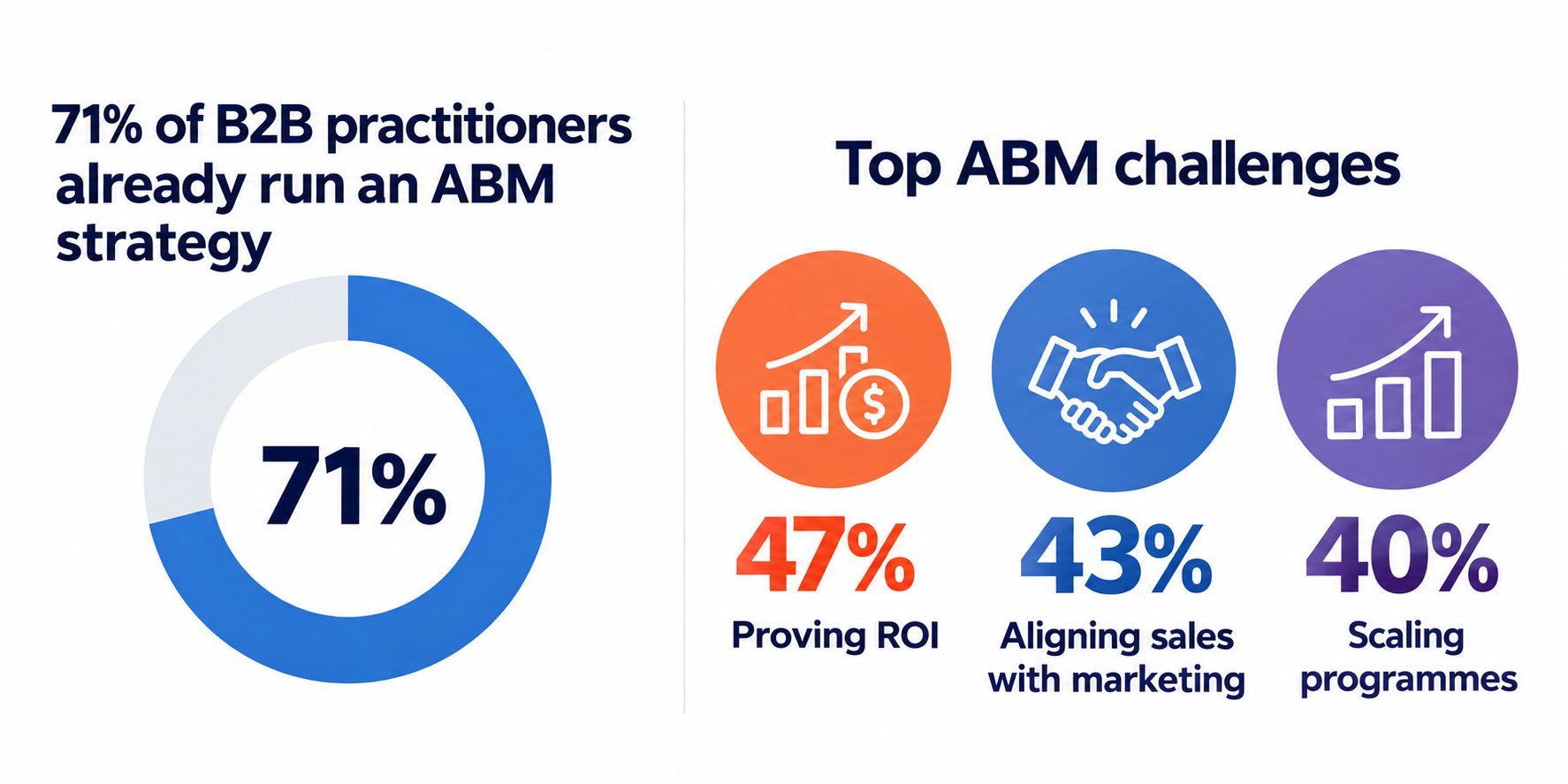
Better upfront planning helps, although sourcing decisions alone will not resolve challenges such as ROI measurement or sales and marketing alignment.
Compliance posture is set at sourcing, in the same way. Recording provenance at sourcing makes later accountability easier, but GDPR compliance also depends on lawful processing and how the data is subsequently used.
Both benefit from being addressed early and reviewed throughout the engagement, rather than treated solely as a final checkbox.
ABM is one of the clearest activation outcomes this affects, and it’s worth making concrete. Before anything is printed and posted for a direct mail campaign service, suppression and address validation have to be settled, not patched in afterwards.
We can’t guarantee the discovery of contacts for which there is insufficient verifiable information, and that don’t exist in any trustworthy source. Where a segment is genuinely undocumented, the honest output is a short declared gap, not a fuller file that quietly papers over it. A declared gap here is the same honesty we apply at delivery, just surfaced earlier.
We also don’t fix duplication as part of enrichment. It has to be resolved first, or the project just compounds whatever duplication was already there.
The result doesn’t hold indefinitely either. Appended data goes out of date like everything else, so a one-off engagement is a snapshot, and an organisation unwilling to refresh it is buying a diminishing asset, however complete it looked on the day it was delivered.
And we can’t compensate for an unclear specification. Where the marketing objective is unsettled, our data enrichment process has nothing to work backwards from, and we’d say so rather than start.
This is what an engagement with us covers, and what it doesn’t. A marketing data strategy still needs clear objectives behind it, because no amount of audit, sourcing, verification, or delivery can supply those on your behalf.
Appending data is the easiest part of all this to automate, and the part that differentiates least between one supplier and the next. What actually sets the outcome is everything around it: what got specified at audit, what got admitted at sourcing, what got verified before acceptance, and what got declared rather than hidden at delivery. The appending is just where that work becomes visible.
That’s what a marketing data strategy actually depends on, not the appending step itself. Done properly, it means ABM programmes with buying group coverage deep enough to run, and personalisation with the attributes to actually support it, not just a first name in a merge field.
It also means audiences activated consistently across email, paid, direct mail and sales outreach, and a foundation dependable enough to build AI-enabled marketing on. Whatever priority Marketing commits to next, the data is ready for it.
References:
1. The state of CRM data management in 2025. (2025). validity.com. Retrieved October 11, 2026, from https://www.validity.com/resource-center/the-state-of-crm-data-management-in-2025/
2. Adverity, McCance, L., Johnson, L., Rennell, T., Adverity, McCance, L., Johnson, L., & Rennell, T. (2025). Fixing the foundation: The State of Marketing Data Quality 2025. In Adverity. https://www.adverity.com/state-of-play-research-data-quality-2025
3. Validity Inc. (2025, August 6). 6 Email Marketing Trends – Validity. Validity. https://www.validity.com/6-email-marketing-trends-you-should-know-to-thrive-in-2025/
4. James Hickey. (2025, December 23). 2025 Demand Gen Report Year in Review Surveys: Insights on AI, ABM, and Events. Demand Gen Report. Retrieved October 11, 2026, from https://www.demandgenreport.com/blog/2025-demand-gen-report-year-in-review-surveys-insights-on-ai-abm-and-events/51159/
5. Forrester. (2026b, January 21). Forrester: The State of Business Buying, 2026. https://www.forrester.com/press-newsroom/forrester-2026-the-state-of-business-buying/