What Is Waterfall Enrichment and Why Does It Beat Single-Source Data?
You upload a thousand target contacts to the platform you already pay for, and four hundred come back blank. No email, no direct dial,…
Read more
Your enrichment dashboard is green. Coverage across the target account list looks strong. Yet your biggest accounts still go quiet in month four, and the objection comes from someone your team never spoke to.
That gap is the subject of this piece. It is not necessarily a data quality problem. It may be a measurement problem, and it decides whether your ABM contact data can carry the top tier.
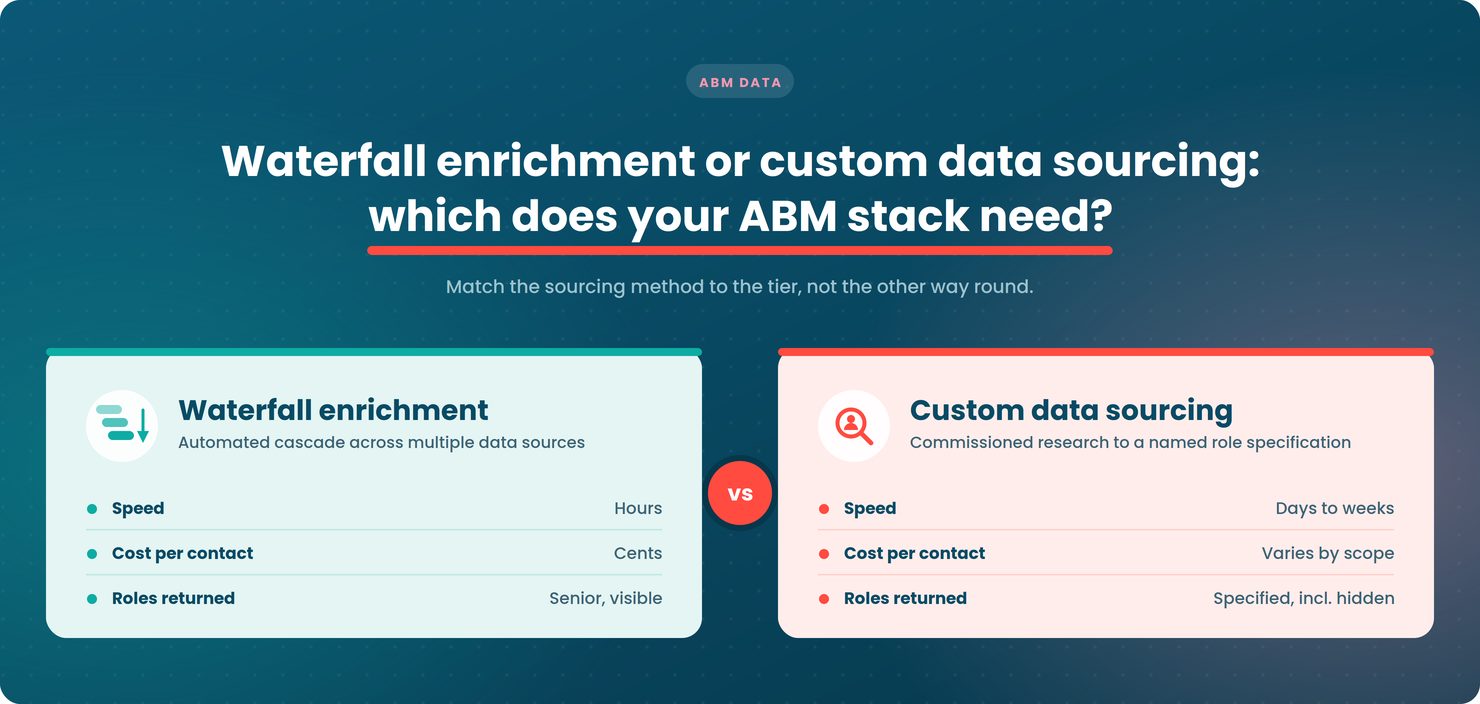
This is a method selection question for a funded programme. We will define both approaches, show why the usual metric misleads, and give you an allocation framework.
The aim is simple. Match the sourcing method to the tier, not the other way round.
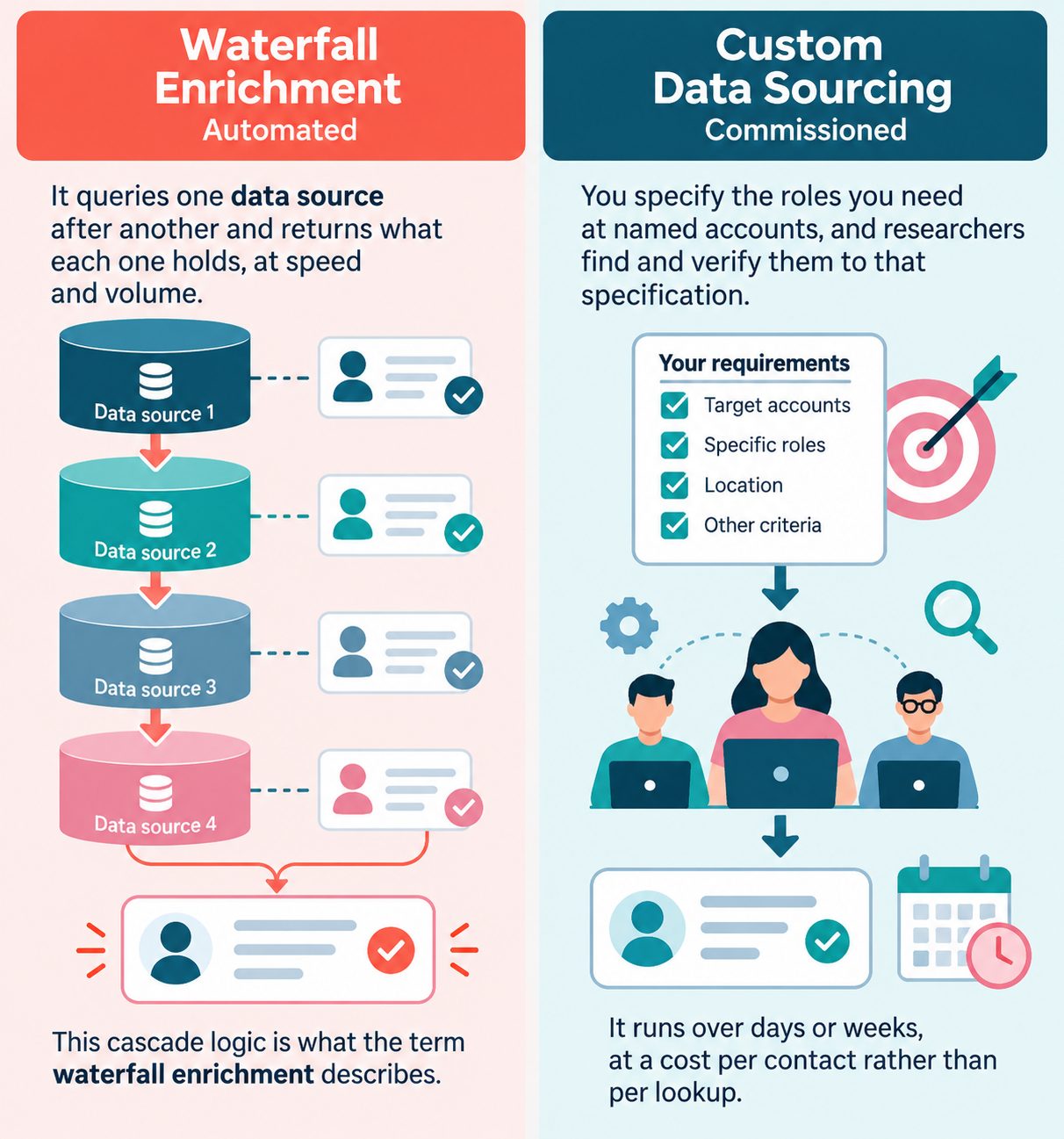
Waterfall enrichment is automated. It queries one data source after another and returns what each one holds, at speed and volume. This cascade logic is what the term waterfall enrichment describes.
Custom data sourcing, sometimes called B2B contact sourcing, is commissioned. You specify the roles you need at named accounts, and researchers find and verify them to that specification. It may run over days or weeks, with pricing typically reflecting the research scope rather than simply the number of lookups.
So one buys you a lookup. The other targets a specified seat on a buying committee, subject to what can be verified. The rest of this piece is about when each is worth it.
Is an 80% match rate good enough for ABM? Not on its own, because match rate answers a different question from the one ABM asks.
Three numbers get used as if they mean the same thing. Match rate is the share of records a source returned data for. It is a file-level figure, and it says nothing about distribution, nor how many contacts per target account you actually hold.
Target account list coverage is the share of named accounts with at least one contact. That is better, though one contact is not a buying group. Role completeness is how many of the roles you need are filled at each account.
It is a useful measure of whether an account has the buying group coverage needed for the programme. Here is the trap. A list of 200 accounts can post an 85% match rate while most accounts hold only the two or three easiest roles.
Fill may concentrate rather than spread evenly.
Enrichment tools may report match rate and target account list coverage.. Role completeness is also important when assessing ABM contact data. It also dates fast.
Some industry estimates put annual B2B contact data decay at around 22.5% a year as people change jobs and move on, although rates vary by dataset. So a healthy match rate is already a snapshot of the past.
Why can’t your enrichment tool find procurement and technical contacts? Automated sourcing depends on the coverage and quality of the sources it uses.
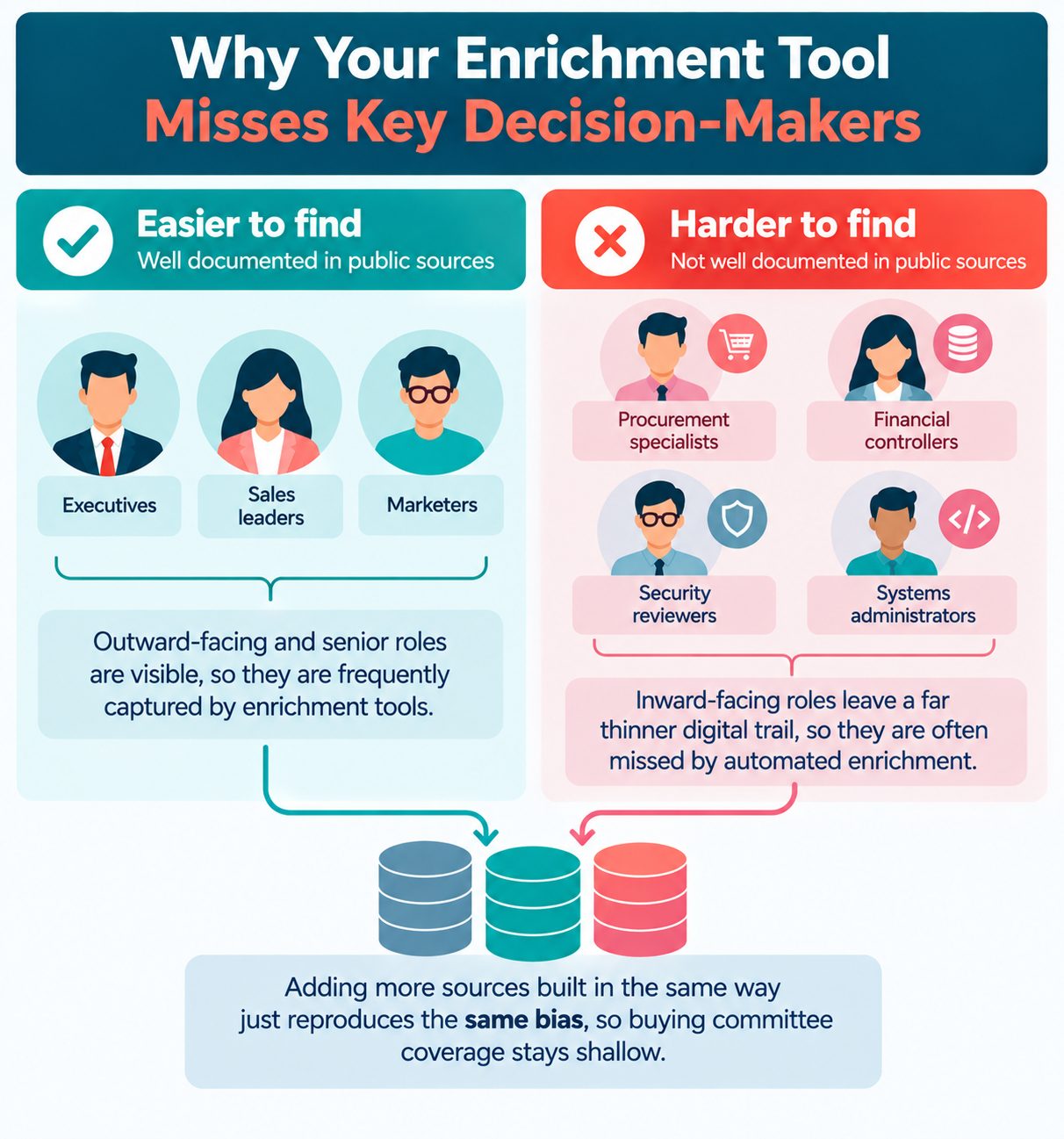
Many data sources draw in part on information published by people and organisations, and visibility can vary across a buying group. Outward-facing and senior roles are documented heavily: executives, sales leaders, marketers, anyone whose job is to be visible.
Some inward-facing roles may be less visible. Procurement specialists, financial controllers, security reviewers, and systems administrators leave a far thinner trail.
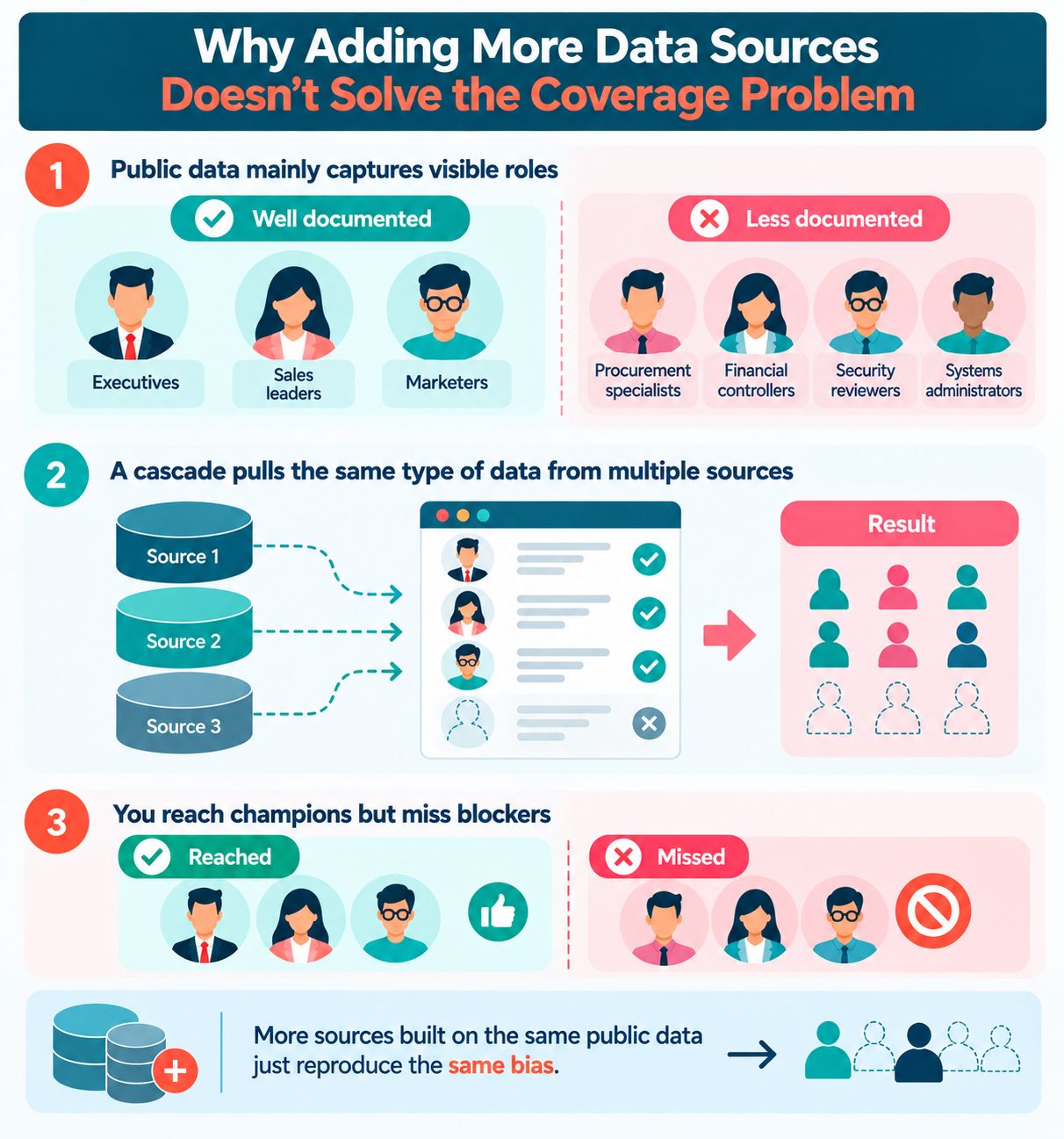
So a cascade may fill more visible roles while leaving gaps elsewhere. Adding sources with similar coverage may not resolve those gaps.
Then the sting. Some missing roles may be influential reviewers or potential blockers that are disproportionately underrepresented. You may only reach the people inclined to say yes and miss the people able to say no.
Gartner now puts B2B buying groups at five to 16 people across as many as four functions, and finds 74% show open disagreement during the decision process. This underlines the importance of understanding the wider buyer group in your target accounts.
The test is blunt. Can your team name the person at each tier-one account who could kill the deal?
Waterfall enrichment earns its place in the stack. Played to its strengths, it is the fastest way to turn a target list into usable ABM contact data. Four things it does well:
That refresh point matters for B2B contact data cost planning, because repeat spend is where the real bill sits. The boundary is simple, though.
Marketing data enrichment returns what is findable, so its coverage is limited by the sources available, and additional spend doesn’t guarantee that gaps will be filled. A good marketing data enrichment service is about using that ceiling well, not pretending it is not there.
What does commissioned contact research actually involve? It starts with a specification, not a search.
You define which roles are required at which accounts, measured against how the buying group really decides. Researchers then work the sources, as automated matching reads poorly:
The output is checked against your specification, not a confidence score. Completion should be assessed against the requested role and verification criteria, not just whether a field is populated.
This is a specification-first approach to B2B contact sourcing that IMG (Intermedia Global Ltd) can support. It is source-agnostic, so it runs alongside the platforms you already licence rather than replacing them.
The parameters differ from enrichment. Volumes and lead times depend on the scope and availability of verifiable contacts. This may be several hundred or a few thousand contacts, whilst ramp-up is measured in days.
The cost per contact can be higher than platform lookup rates, and that is the B2B contact data cost you weigh against the value of the account. All figures here are directional.
This is not manual versus automated. Commissioned research can use programmatic enrichment as a first pass, then puts researchers on what it could not resolve. Paying a person to find what a cascade returns in seconds is waste.
That is really the data enrichment API vs service question, and the answer may be a combination of both. So the two are stages, not rivals. If a supplier charges research rates for the whole file, ask what share the first pass resolved.
Here is how the two compare on the things that decide an ABM programme. The rows do not all point the same way. This is an allocation decision, not a quality ranking.
| What matters for ABM | Waterfall enrichment | Commissioned research | Why it matters at tier 1 |
|---|---|---|---|
| Roles reliably returned | Senior, visible roles | Specified roles, hidden buyers included | The economic buyer is often the hard one to find |
| Time to deliver | Hours | Days to weeks | Tier-one lists are small and planned ahead |
| Cost per usable contact | Cents | Varies by scope | Trivial against a top-tier deal value |
| 50 vs 5,000 accounts | Designed for scale | Suited to smaller, named lists | Top tiers are dozens, not thousands |
| Records neither resolve | Left as gaps | Researched further; unresolved gaps flagged | Gaps at tier one are where deals stall |
Read as a whole, this is why strong B2B contact sourcing blends the two rather than picking one.
Should you commission research for your tier-one accounts? For most ABM programmes, it can be worthwhile where account value and missing roles justify the investment.
Tiering is how ABM allocates depth, personalisation and sales capacity, so sourcing method belongs in that same decision. Ask how many contacts per target account you really need.
A top tier of a few dozen accounts needing eight to 15 roles each can amount to a few hundred contacts. Assessed against top-tier deal values, the ABM contact data behind those accounts is worth paying to complete.
The wider research supports the importance of buying-group alignment and ABM, although it does not directly prove the ROI of commissioned contact research. Buying groups that reach consensus are 2.5 times more likely to report a high-quality deal, and 82% of organisations say ABM returns more than traditional marketing.
A programmatic tier running to thousands inverts every term. Per-contact research may become uneconomical. Programmatic activation may prioritise account-level reach over complete individual role coverage.
The middle tier is genuinely mixed, so treat it that way. One method across all tiers overspends at the bottom or underserves at the top.
Sometimes commissioned research is overhead. Enrichment alone may be sufficient in five situations.
That last point is really a sequencing question: does your CRM need first cleansing, enrichment or sourcing? Sort the order before you spend.
In all five cases, enrichment may provide sufficient buying group coverage without paying for research you will not use.
Match the method to the tier. Here is a practical starting point for allocation:
This is where IMG (Intermedia Global Ltd), a London-based B2B marketing consultancy, fits. IMG (Intermedia Global Ltd) works source-agnostically, alongside the platforms you already hold, so the B2B contact sourcing you commission builds on your existing licences rather than duplicating them.
For the top-tier case, that means marketing data sourcing and acquisition against a defined buying group, not another bulk list. The aim is buying committee coverage you can activate, not just a longer ABM contact data file.
Define the roles first. These decisions usually happen in the wrong order. A method gets chosen, contacts arrive, and only when the programme stalls does anyone ask which roles were needed.
Reverse it, and the problem becomes tractable. Name the roles that have to be present for an account to be workable.
Measure how many are filled at each account. The gap tells you which tier needs which method, and it surfaces the missing decision makers in your target accounts before launch rather than after.
Done this way, your programme starts with the buying groups it needs, not the contacts a filter happened to return. The specification does one more thing, too. It is what makes buying group coverage measurable in the first place.
References: