Why Buying More Data Isn’t Always the Right Answer to Incomplete Records?
Why Buying More Data Isn’t Always the Right Answer to Incomplete Records? The renewal quote arrives twelve months after the last one, and the…
Read more
The budget’s approved. The data fix is finally happening. And now there are three quotes sitting on your desk, each for a different thing.
One is for marketing data cleansing. One is for enrichment. One is for B2B data sourcing. Three suppliers, three prices, three confident pitches.
So you do what anyone would. You search “data cleansing vs data enrichment” and look for a verdict on where to start. Nearly every article hands you the same one. Clean first, then enrich, then source. None of them asks a single question about your database, your market, or the campaign you’re trying to run.
That generic answer is usually right. Sometimes it’s expensively wrong.
Here we give the standard advice which is due, name the one condition that breaks it, and hand you a diagnostic for your own CRM data gaps so you fund the right fix first.
TL;DR
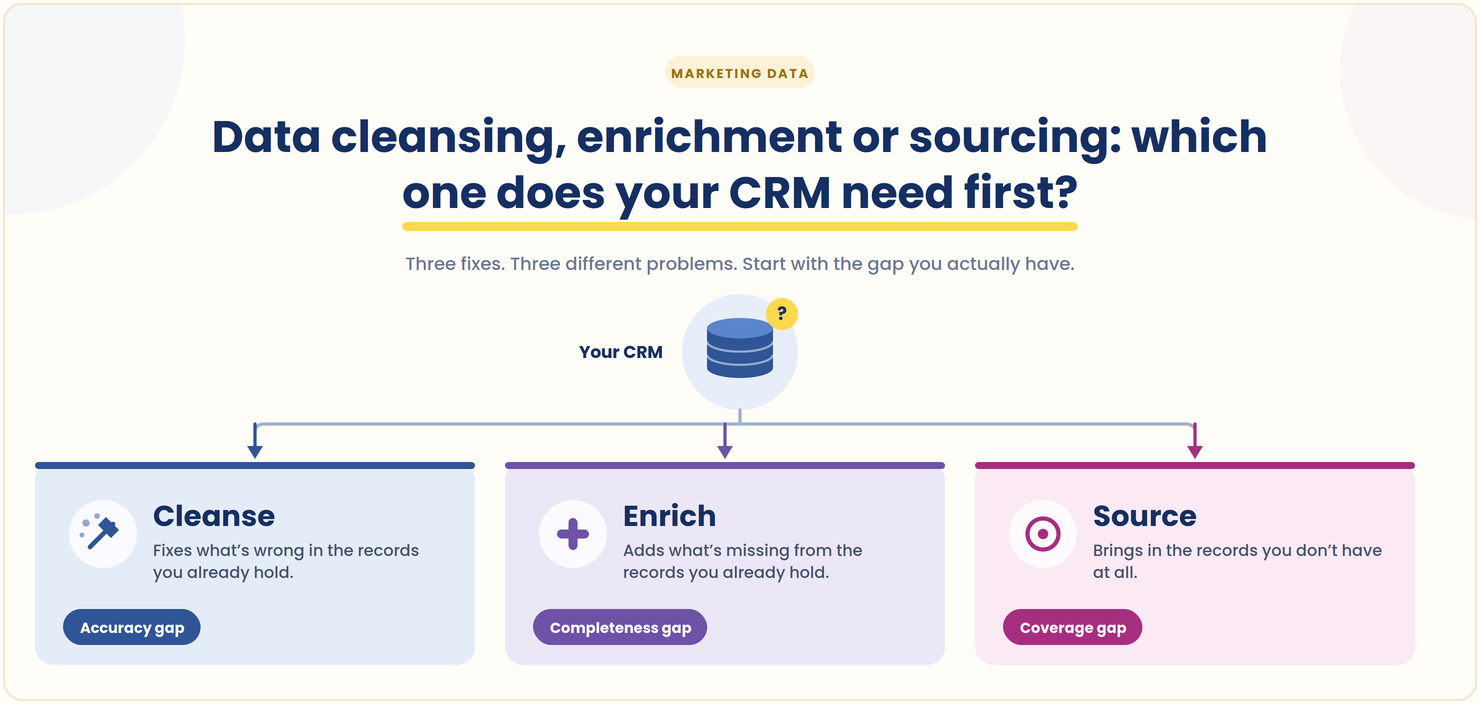
Cleansing fixes what’s wrong in the records you hold. Enrichment adds what’s missing from them. Sourcing brings in the records you don’t have at all.
They’re three answers to three different problems. The data cleansing vs data enrichment debate only matters once you know which problem is actually yours.
Buy without knowing that, and your data budget goes to the wrong fix.
If you’re asking whether to tackle data cleansing or enrichment first, the standard answer is cleansing, and it earns that position on cost grounds alone.
Enrichment is typically priced per record or per successful match. Append fields to a duplicate, and you’ve paid for data that two records now hold instead of one.
Merge those duplicates later, as you eventually must, and you pay again, in time, in lost fields, in deciding which enriched version survives the merge.
This isn’t a fringe problem. Salesforce research, cited in Validity’s 2024 State of CRM Data Management report, found the average customer contact database holds more than 25% duplicates.
The same report found 53% of companies say they actively struggle with CRM duplicate records.
Another reason for prioritising cleansing is less often explained. Enrichment matching works off the record you feed it.
A malformed field, an inconsistently spelled company name, a stale domain – each one depresses the match rate, because the enrichment provider can’t confidently match what it can’t clearly read.
So cleansing doesn’t just prevent wasted spend on duplicates. It raises the yield of every record you go on to enrich.
If your current CRM holds the audience you need, the consensus answer here is the right one. Do I need to clean my CRM before enriching it? Yes, and not as a formality.
Cleanse-first assumes the people you want to reach are already sitting in your CRM, just recorded badly. When they’re not in there at all, cleansing optimises the wrong asset. You end up with a beautifully maintained database of the wrong companies and incomplete buying groups.
This isn’t an edge case either. It’s the default position in several common situations such as entering a new geography, launching against a new ICP, or standing up an ABM programme against named accounts your business has never marketed to.
Or, more quietly, a CRM that’s simply the record of a decade of inbound enquiries rather than the market you’ve since decided to pursue.
There’s a clear diagnostic symptom that separates this from a hygiene problem. Your data passes quality checks. Deliverability is fine. Open rates and match rates look healthy.
And campaigns still underperform because the issue was never the state of the records. It’s which records exist. No amount of data cleansing or enrichment fixes that, because both work on records you already hold.
This doesn’t reverse the rule in the previous section. It contextualises it. Should I clean data before enriching? Still yes, where the audience is present.
Where existing audience coverage is limited, data sourcing may be the immediate priority. However, any new data should be validated and reconciled against existing records before integration to avoid introducing duplicates or inconsistencies. Cleansing, enrichment, and sourcing can therefore be sequenced or combined depending on the specific requirements.
Take the next campaign you’ve committed to, define the audience it requires, then measure your database against that – and not against itself.
That reframe matters. Most data quality assessments measure the database against itself. Completeness percentages. Duplicate rates. Match scores. These tell you the state of what you hold. They tell you nothing about whether what you hold is the right thing to hold.
It’s also why “my CRM is full, but campaigns underperform” is such a common position. A database can score well on every internal metric and still fail the one that matters:
Does it cover the addressable market this campaign needs?
A major 2024 study conducted by Salesforce found 41% of companies halted potentially valuable initiatives in the past twelve months because of low-quality CRM data, and a database that’s only ever measured against itself will miss plenty of those cases entirely.
The symptoms are easy to spot once you’re looking:
The accounts and contacts you want are present. What’s recorded about them has degraded, or was never consistent to begin with, and that’s not a one-off.
48% of CRM admins have noticed their customer data decay accelerating over the past year, according to The State of CRM Data Management research conducted by Salesforce in 2024. On bounces specifically, most deliverability guidance treats anything sustained above roughly 2% as a sender reputation risk, not a blip.
This is where a marketing data cleansing service applies, and the most common one in CRM duplicate records specifically. One limit worth naming is that cleansing can’t tell you anything about people who aren’t in the file. For that, look to B2B data sourcing and acquisition service instead.
But even clean databases face challenges. You can’t segment the way the campaign brief requires. Personalisation collapses to first name because nothing else is populated. Lead scoring misfires because the fields it depends on are empty. An account looks covered on paper, but the buying group behind it is one contact deep.
The records are accurate. They’re just thin. The aforementioned CRM study (2024) found 68% of CRM admins report incomplete data and 65% report missing data outright, and nearly 25% say less than half their data is accurate and complete.
A marketing data enrichment service closes this gap, often run as waterfall enrichment to maximise buying group coverage across multiple sources.
It’s worth distinguishing clearly from the accuracy gap above, because the two get conflated constantly and the remedies aren’t interchangeable. A record can be entirely correct and still unusable.
The tell here sits at the market level rather than the record level, because your target account list and your CRM overlap far less than expected. A whole segment is thinly represented. The database reflects historic inbound rather than the addressable market you’ve decided to pursue.
This is the B2B data sourcing case, and it’s the one marketing data enrichment can’t fix on its own, since you can’t enrich your way into accounts that were never captured.
The measurement that exposes it is straightforward but frequently skipped. You match your defined target account list against what’s actually in the database. Most teams don’t run it, because it means assessing the market they want rather than the data they already have.
If you’re still asking how to know whether your data problem is accuracy or coverage, this is the test. Accuracy gaps show up inside records you hold. Coverage gaps only show up once you compare against a market you haven’t yet captured.
This has rarely been a choice between data cleansing vs data enrichment vs B2B data sourcing. It’s a question of where to start and what follows, because most CRMs need two of the three to run in sequence.
Where the audience is substantially present, the sequence is cleanse, then enrich, then source only to close whatever gap the first two steps expose. Should I clean data before enriching?
Yes, and that order also makes any later sourcing spend smaller and better targeted, because by that point you know precisely what’s missing rather than guessing at it.
Where the audience is largely absent, the sequence changes. Define the target market, define your coverage gap, source against it, cleanse the combined file, then enrich.
This is also where buying data usually fails: teams source first and skip the cleanse step, so the new records are added into a database of old problems, just at a larger scale.
One principle sits underneath both sequences. Never buy before you know what you already hold. The question of when to buy new data vs clean existing records always traces back to that.
Six situations cover most readers, and the table below maps each to a starting point, a follow-on step, and what it actually unblocks for marketing, rather than treating this as a procurement decision.
Most of these resolve the data cleansing vs data enrichment question in one direction. A couple doesn’t, because the audience itself is the problem.
And the last row is the honest answer for a large share of readers. You genuinely can’t tell which situation you’re in yet, and that’s a measurement challenge worth solving before any spend is committed.
| Your situation | Start with | Then | What it unblocks for Marketing |
|---|---|---|---|
| High bounce rates and duplicates, audience broadly present | Cleanse | Enrich | A segmented campaign built on records that actually deliver |
| Audience present, but segmentation and personalisation are impossible | Cleanse | Enrich | Personalisation and lead scoring that work as designed |
| Entering a new geography or vertical | Audit and Source | Cleanse the combined file | Market entry on an addressable base from day one |
| ABM launch against accounts never marketed to | Audit and Source | Cleanse the combined file | An ABM programme with the named accounts actually present |
| Database untouched for two or more years | Cleanse | Enrich, source if degraded | A multi-channel programme run on a dependable base, not a decayed one |
| You can’t yet say which applies | Audit against your target account list | Act on what the audit finds | Clarity on where the first pound of data budget should go |
CRM data gaps rarely resolve from a single purchase, which is the position (IMG) Intermedia Global Ltd works from. As a UK-based B2B marketing experience agency, we deliver this through a single set of marketing data services such as data cleansing, enrichment, and sourcing and acquisition as one sequenced programme rather than three separate line items.
A database assessed against itself will always look like a hygiene problem, because that’s the only thing that kind of assessment can see.
Assessed against a specific programme with a defined addressable market, the same database often reveals a coverage problem instead.
That’s why buying data fails so often when it’s the first move rather than the second. So the real first step isn’t to buy a service. It’s to name what the next campaign has to reach, then measure the gap between that and what you already hold.
Get that right, and the outcomes follow:
One final point worth adding is that marketing data strategy sits above all three of these, not alongside them as a fourth option. It’s the layer that decides when to buy new data vs. clean existing records in the first place.
Reference:
1. Salesforce. (2024). The state of CRM data management in 2024. https://www.validity.com/wp-content/uploads/2024/05/The-State-of-CRM-Data-Management-in-2024.pdf