Before the platform, before the change, start with why
Most CRM conversations begin in the wrong place. They start with which platform, or which features, or what the last one didn’t do. The…
Read more
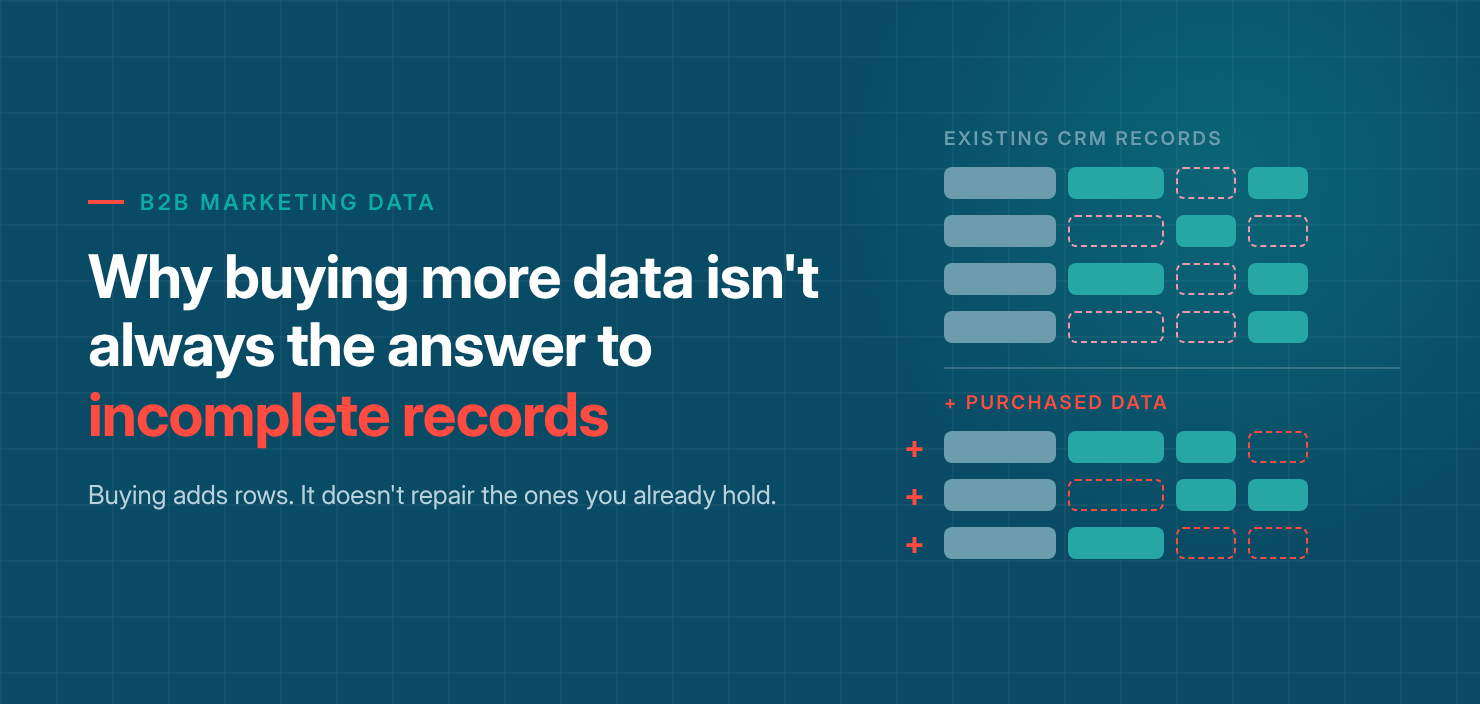
The renewal quote arrives twelve months after the last one, and the team goes on to buy another batch of credits for their data platform subscription. They upload contacts to the CRM and move on. For some businesses, that works just fine. For others, the next campaign goes live, and the same questions surface:
That is the uncomfortable pattern behind buying B2B data – for some companies.
So, is buying data lists worth it?
Sometimes, absolutely. New markets, genuinely missing accounts, incomplete buying groups, and specialist audiences can all justify sourcing new records. The problem starts when every data gap is treated as a sourcing problem.
This is where a marketing data strategy service matters. Without one, it is easy to keep adding data without fixing why existing records remain incomplete.
And it leaves one question hanging: Why does buying more data never seem to fix our CRM?
TL;DR
A campaign underperforms. Target accounts are missing, contact coverage is thin, and teams cannot segment the audience as planned. The diagnosis people reach is that marketing needs more data.
Then the team adds another platform subscription to access more records, and fill rates improve. For a while, the problem appears solved.
The next campaign arrives.
Some of the same gaps are back. The CRM still contains incomplete CRM records, missing fields remain missing, and teams discover that having more rows has not necessarily made the audience more usable.
So another request goes in. Eighteen months later, the same conversation is happening again, perhaps with a different vendor or a larger package of licences.
This is the cycle behind stacking data platforms. The same data gaps come up again and again, accelerated by the natural decay of contact records as people move throughout their careers.
You may even find yourself thinking, “We keep buying data, and it doesn’t help.”
Let’s see why that cycle repeats, why adding records does not automatically repair existing gaps, when buying new data genuinely makes sense, and what needs to change before the next purchase.
A data purchase is, at its most basic, an append operation. New rows are added to an existing table, increasing the number of records available to marketing. That can be useful when the business genuinely needs accounts or contacts it does not currently have. But adding new rows does not change the condition of the rows already sitting in the CRM.
And that is where the pattern starts to make less sense.
A campaign does not fail simply because the CRM has too few rows. It can fail because a contact has changed employer, a record already exists elsewhere in the database, a critical field is missing, or the account has only one person attached to it. None of those problems is automatically resolved by buying B2B data.
The same applies when the problem is more structural. A campaign may require a specific combination of attributes, but a vendor can only supply the fields available in its database. A business may therefore buy thousands of records and still lack the information needed to segment or activate them properly.
This is why asking “is buying data lists worth it” can be the wrong question on its own. The more useful question is what happens to the records you already own.
The result is that the fill rate on a dashboard rises, while the original campaign failures remain. The database looks fuller, but Marketing may still struggle to identify the right people, build usable audiences, or reach the accounts that matter.
More data and better data are not automatically the same thing. The distinction becomes clearer when you look at what a purchase cannot repair.
The contact details may have been correct when they were captured. Since then, the person may have moved to another employer, changed role, or left the organisation altogether. A new purchase might identify the replacement, but the original row remains in the CRM unless someone updates or removes it.
That creates a simple problem: the old record can continue to qualify for campaigns even though its information is no longer current.
This happens continuously, and the scale of it is measurable. HubSpot’s analysis of MarketingSherpa research puts B2B database decay at roughly 22.5% a year as people change jobs, companies restructure, and roles are created, removed, merged, and reassigned.
So the question “why does our purchased data go stale” cannot be answered only by looking at when the data was bought. The existing records need attention too.
Appending a new list can produce matches against records already held in the CRM. Without proper resolution, both records survive, often with different values in different fields. One may have the newer job title, while the other contains the better company information.
That creates more than a database problem. The same person can receive the same campaign twice. Engagement can then be split across two rows, making neither record appear as strongly engaged as it should. Account reporting can also understate coverage because activity and contacts are fragmented across duplicate records.
This is the classic case of duplicate records in CRM, where adding more data can increase the number of records without increasing the number of genuinely useful people or accounts.
It is also widespread. Validity’s State of CRM Data Management in 2025 report, surveying 602 CRM users and administrators, found that 76% say less than half of their organisation’s CRM data is accurate and complete, and 37% say their company loses revenue directly as a result.
This is often the least visible problem. A record can be accurate, current, and unique and still be unusable for a particular campaign because the attribute that matters is missing.
Perhaps Marketing needs seniority to build an audience. Perhaps the campaign depends on function, industry, or buying-group role. If that field is empty, having a valid email address does not solve the campaign requirement.
Fill-rate reporting can hide this distinction because it measures how many fields contain something, rather than whether the required fields contain the right information.
So the issue is not simply whether a record is complete. It is whether it is complete for the job Marketing needs it to do.
A purchase can increase the number of contacts linked to an account without materially improving the ability to reach the people involved in a decision.
In B2B, buying decisions can involve multiple stakeholders across different functions and levels. An account with one contact may therefore appear covered in the CRM while leaving most of the relevant B2B buying groups unidentified.
The distinction matters because contact volume is not the same as buying group coverage. Having more names does not necessarily mean having the economic buyer, technical stakeholder, procurement contact, operational owner, or other people involved in the decision.
This is why a rising contact count can create a misleading sense of progress. The database gets bigger, but the account may still lack the depth Marketing needs to build a meaningful audience.
A data platform licence gives a team access to a database. It does not guarantee that the database contains the specific records, fields, or B2B data coverage required for the campaign in front of them.
That distinction matters when organisations buy broad access but still encounter gaps in the markets, industries, roles, or accounts they actually need. Buyers may also encounter annual commitments, credit models, seats that go unused, and variable coverage between markets, all part of the cost of bad data that rarely shows up on the invoice itself.
The result is a subtle but important mismatch between access and usability. The organisation can search millions of records, yet still struggle to build the audience required for one campaign.
Before recommending anything new, IMG (Intermedia Global Ltd) checks whether a client’s existing platforms and licences already cover the requirement. A licence is something IMG will keep or combine, not sell by default.
A licence can therefore solve an access problem without solving a data requirement.
That is also why asking “How often should you buy new data?” misses the bigger issue. The frequency of purchasing does not tell you whether the data already sitting in your CRM is accurate, complete, deduplicated, and fit for the next campaign.
And it brings the cycle back to the same conclusion: “We keep buying data, and it doesn’t help.”
Buying B2B data is reasonable when the business is entering a geography or segment where it currently has no meaningful coverage, launching against named accounts it has never approached, replacing a dataset that is old enough for correction to cost more than replacement, or filling a specific gap already identified through an audit.
This is the audit our team at IMG (Intermedia Global Ltd) runs before recommending any purchase. We assess existing coverage against the next campaign’s requirements to establish whether a gap is real, and how big it is.
Two purchases can look identical on a purchase order. For instance, the same type of supplier, a number of records, a delivery date, and a budget. Yet they behave very differently afterwards.
In one case, the purchase adds coverage that did not exist. In the other, it adds records without addressing the existing problem that caused the campaign gap in the first place.
What you need to ask before approving another B2B database purchase is, “What do we know now that we did not know when we bought the last set?”
The answer should come from your marketing data strategy and a clear assessment of the data required for the next campaign. You should know which records are missing, which fields are required, what coverage already exists, and what the new purchase is expected to add. You should also know how much of a purchased list you already have before buying data lists again.
This is the point at which incomplete CRM records become relevant. A new purchase can fill a known gap, but it does not repair the records you already hold.
The cost of poor data is often presented as a large business-wide number.
IBM, in its article “A compounding threat: The true cost of poor data quality” published in January 2026, reported that more than a quarter of organisations estimate they lose over US$5 million annually because of poor data quality, with 7% reporting losses of US$25 million or more. But the more relevant cost here is what happens when the same data problems
Buying B2B data creates work before and after the supplier delivers the records. Teams scope requirements, compare suppliers, review files, reconcile them against the CRM, and prepare them for activation.
Some of those new records will overlap with what the business already has. Others may introduce different conventions or fields that make the database harder to manage.
Then the campaign waits.
When marketing cannot trust the available data, teams delay launches, audience builds, segmentation decisions, and ABM activity while they wait for the next dataset.
The cost of bad data therefore compounds through repetition: not because the organisation holds imperfect records, but because the same problem keeps triggering another response.
That makes the question “is buying data lists worth it” too narrow. The better question is what each purchase adds after the business already knows its addressable market, existing coverage, and unresolved gaps.
| Cost | Why it recurs | Why it stays invisible | What it delays for Marketing |
|---|---|---|---|
| Internal time across scoping, procurement, review and loading | Every purchase creates another cycle of requirements, supplier management, file checks, reconciliation and CRM loading | The work is spread across Marketing Operations, Procurement, Sales and Marketing rather than appearing as one line item | Campaign preparation, audience building, activation and launch |
| Overlap paid for twice | New lists are often built against similar ICP criteria and, without suppression, can contain people or accounts already held | Supplier invoices show records purchased, not records that are genuinely new to the business | Budget available for new audience development and ABM activity |
| Campaigns and decisions deferred waiting for the next dataset | Teams wait for new records when existing coverage cannot answer the immediate campaign requirement | The delay appears as a postponed project rather than a data-related cost | Campaign launches, segmentation decisions, account selection and ABM programmes |
| Compounding inconsistency as each purchase adds its own conventions | Different sources can structure fields, titles, company names and other attributes differently | Each purchase looks acceptable in isolation, while inconsistency accumulates across the CRM | Consistent segmentation, reporting, personalisation and cross-channel activation |
The more precisely you define your ICP, the greater the chance that another list built against that same ICP contains records already sitting in your database.
Your addressable market does not change because you changed vendors. If your team and the supplier are both targeting the same industries, company sizes, geographies, roles, and account characteristics, there is a natural opportunity for overlap and for duplicate records in the CRM if that overlap goes unresolved.
This is the match-count check IMG (Intermedia Global Ltd) runs before any new sourcing: comparing a proposed list against the client’s existing CRM so budget is only spent on records that are genuinely new.
Before approving another B2B database purchase, ask the vendor to run a match count against a representative sample of your existing records. The result tells you how much of the proposed dataset is genuinely new before you commit to your next purchase. A reluctance to provide that comparison is information in itself.
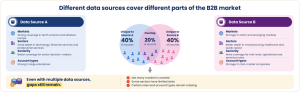
One more licence can give Marketing access to millions of additional records and still leave important gaps untouched. That is because B2B data coverage is shaped by how each provider collects, verifies, and maintains its information. Coverage gaps are therefore rarely random.
A provider may have strong coverage in its home market but less depth elsewhere. It may perform well for industries where company and contact information is widely available, while offering thinner coverage in sectors where people publish less information.
Senior decision-makers may be easier to identify than the operational or technical roles that often influence or stall a buying decision.
This creates a practical problem for anyone buying B2B data. If one source does not cover a particular audience well, replacing it with another can simply move the gap.
Buying a second generalist platform can reproduce similar limitations, leaving Marketing with two broad databases but no meaningful improvement in the specific coverage it needs.
IMG (Intermedia Global Ltd) is source-agnostic and uses waterfall enrichment across multiple global and specialist sources, so a gap in one provider is filled by another rather than by a second licence.
The better question is not simply “Does adding new records fix existing bad records?”
It is:
“What coverage do we actually have, what is missing, and how much of the proposed dataset do we already own?”
That means checking how much of a purchased list you already have before committing to another source, and understanding which markets, sectors, roles, or account types remain underrepresented.
Marketing data enrichment service should therefore begin with the gap that needs closing, not with another licence. A larger database is not necessarily a more complete one. The useful measure is whether it gives Marketing the specific coverage required for the next campaign.
Teams keep buying data because, under campaign pressure, it is a practical and familiar response. Marketing has a deadline, the audience is incomplete, and a supplier can offer more records quickly.
A B2B database purchase is also easy to explain internally. It has a supplier, deliverables, a budget, and an established procurement process. Someone can point to the decision in a review.
Diagnosis is harder to package. Before remediation can begin, someone has to determine which records are wrong, which fields are unreliable, where coverage is missing, and why existing data is failing the campaign. That work often has no obvious budget line and remains largely invisible until it produces a result.
Speed matters too. Buying B2B data can happen within the campaign cycle. A diagnostic exercise cannot always move at the same pace, while campaign calendars continue regardless.
There is also a supply-side reason. Data vendors are already positioned to sell the purchase. They can demonstrate the platform, show the available records, and provide a route to approval. The people who could investigate the underlying problem are not necessarily part of that conversation.
That creates the central diagnostic gap – adding records requires no knowledge of which records are wrong or why they are wrong.
So the purchase happens, while the causes like duplicate records in CRM, missing fields, weak account coverage, and outdated contacts remain in place. The next campaign then exposes the same gaps, and the cycle starts again.
The starting point is not the database. It is what Marketing has committed to do next.
A new ABM programme, a campaign into a new market, tighter segmentation, personalisation at scale, or a specific set of target accounts will each require different data. Your marketing data strategy should therefore begin with the objective and work backwards to the data required to achieve it.
IMG (Intermedia Global Ltd), a London-based B2B marketing consultancy, takes this approach across data strategy, auditing, cleansing, enrichment and sourcing.
The process starts by assessing what the client already holds against the requirements of the next marketing objective, rather than assuming another purchase is the answer.
The sequence is straightforward:
IMG (Intermedia Global Ltd) also works with the platforms and licences a client already holds rather than replacing them by default. The purpose is to make existing data more useful, identify the real gaps, and add coverage only where the evidence shows it is needed.
Knowing your total addressable market data shows how large the opportunity is. It does not tell Marketing which organisations it can actually reach.
IMG (Intermedia Global Ltd) builds this account-level addressable-market view using geography, sector, revenue, size, technology and growth criteria, then matches it against the client’s CRM to show accounts held, missing, duplicated and under-enriched.
The resulting picture is far more useful than assessing the database against itself. You can identify:
That changes the question from “How many records do we have?” to “How much of the addressable market we actually want to reach is represented in our data?”
This matters because a database assessed only against itself can make every problem look like a hygiene issue. A defined addressable market gives Marketing an external reference point and shows where B2B data coverage genuinely falls short.
Holding the account is not the same as being able to reach it.
In B2B, a buying decision can involve economic buyers, technical evaluators, operational stakeholders, procurement, finance, influencers, and end users. The required mix depends on the proposition, but the principle remains the same: one contact rarely represents the whole decision-making group.
IMG’s (Intermedia Global Ltd) audit checks contact density per priority account against the roles the proposition actually requires, not total contact count. Checking buying group coverage this way, before buying more contacts, is how IMG confirms whether an account is genuinely covered.
The B2B buying groups within an account are what Marketing needs to understand and engage. An account with one contact may therefore appear covered while leaving the wider decision group unidentified.
The consequence is particularly important for ABM. Account selection without sufficient buying group coverage can limit the ability to activate the programme at all. The objective is not to maximise contact volume. It is to build the right coverage inside the B2B buying groups that matter.
Once the gaps are known, the remedy follows the diagnosis. It is rarely one thing.
CRM data cleansing resolves problems in the records you already hold, including duplicate accounts, duplicate contacts, invalid records, incomplete CRM records, inconsistent field formats, outdated employment information, and conflicting information.
B2B data enrichment then adds the attributes required for targeting, segmentation, personalisation, and activation. That can include seniority, function, industry, geography, company size, technology usage, account hierarchy, buying-group information, and behavioural or intent data.
IMG (Intermedia Global Ltd) cleanses and enriches existing records first, then sources only the specific accounts and contacts the gap analysis shows are missing. Because the existing records have already been resolved and enriched, the requirement is narrower and more precisely defined.
That ordering matters. Never append to a file you have not resolved, and never commit to a B2B database purchase before you know what you already hold.
The goal is to preserve what is valuable, improve what can be improved, and source only what the evidence shows you do not have.
IMG (Intermedia Global Ltd) regularly sees marketing teams juggling licences and access to multiple data platforms, while still questioning whether they have the right data to support their next campaign or growth priority. The challenge is often not access to more data, but knowing what you already have, what is usable, and what is actually missing.
More data does not automatically create better marketing. What matters is whether the data you have is fit for the marketing you are trying to deliver.
The question is not simply how often you should buy new data; it is what Marketing needs the data to make possible next.
Your marketing data strategy should start there. If the next priority is ABM, buying group coverage needs to be deep enough to reach the people involved in the decision. If it is personalisation, the records need the attributes that make meaningful segmentation possible. If campaigns need to run across email, paid, direct mail, and sales outreach, audiences need to be consistent across those channels.
Performance also needs to be measurable against meaningful audience characteristics, not just record counts or delivery volumes. And as AI becomes part of marketing execution, the underlying data needs to be dependable enough to support those use cases.
In other words, the requirement should be defined by the use case first and the data assessed against it second.
That changes how you approach a B2B database purchase. Before asking Is it worth buying another data list, understand what you already have, resolve the duplicate records in CRM, and define what is genuinely missing.
It also answers: why do companies keep buying data that doesn’t work? Because adding records feels like progress when the underlying requirement has not been defined.
Start with what Marketing has committed to do next. Make sure the data is ready for it. Then fill the gaps that are actually holding you back, rather than simply adding more data. That creates a stronger foundation for whatever comes next, whether that is ABM, personalisation, multi-channel activation, or AI.